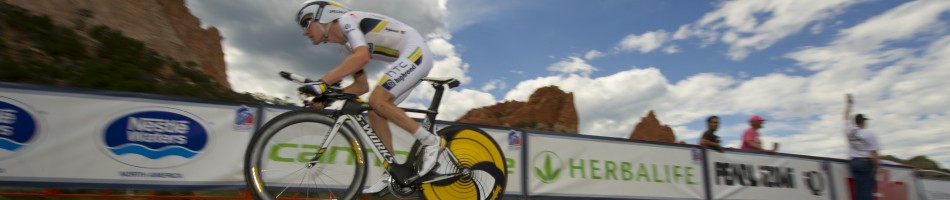
Bring The Challenge
I’m watching the second stage of the USA Cycling Challenge on my laptop while I write this. Don’t tell my daughter, but I will know the results long before I turn on the big-screen tonight. Today, some of the very best cyclists in the world are riding a road I pedaled back in June, over Blue Mesa and past the reservoir before the first sprint point in Gunnison. I’m planning my weekend, as the race will cruise near Allenspark, through Lyons and into Boulder on Saturday. The race concludes in Denver on Sunday. Thanks to NBC, the whole world will see some of the amazing terrain we get to see all the time. Wouldn’t it be nice if the world got to see our little piece of Paradise?
Local cycling enthusiasts would love to lure the race through Estes Park for 2013, I among them. I realize that our little town probably doesn’t have the money to host a start or a finish, but wouldn’t it be nice just to have some of the fittest athletes on earth come cruising through, bringing fans and fan dollars with them?
There’s more. My mother-in-law will occasionally sit down and watch broadcasts of the Tour de France, not because she’s any kind of cycling fan, but because the cameras often pan to show a wider view of the area the riders a racing through. During these broadcasts, she and my daughter will say, “we really need to go there.” With NBC beaming images of Colorado to 200 countries, I’m pretty sure some family, somewhere, will express the same thing. That could lead to more visitors.
I have friends who have visited some of those areas of France that I watch every July. With climbs here like Trail Ridge Road, an enthusiast from France or Switzerland is bound to heed the call and bring a family, as well as a bike, with them.
I don’t know the economic statistics of cycling tourists from other nations. I know that in the case of cyclists who participate in Ride the Rockies, they average a yearly income in the six-digit range. While the immediate impact of the race coming through might be good, lots of folks grabbing lunch or drinks or gifts while awaiting the peloton, the long-term impact would be better than any of the advertising our local promotional groups can afford.
It’s more than the lycra-covered butts or shaved legs. Fans enjoy the views of the high peaks, the waterfalls, the historic mining districts, our state’s history. All of this would be shared with millions of cycling fans all over the world. We have plenty of scenery and history for visitors to enjoy.
Now then, day one of the USA Cycling Challenge saw Garmin-Sharp rider Tyler Farrar score his first win in over a year. On a day that was much faster and much harder than anyone anticipated, Farrar and the main peloton caught Garmin-Sharp teammates Tom Danielson and Peter Stetina just outside of the finishing town of Telluride. A break-away group powered off the front less than six miles into the 125.6-mile stage. The break went out so hard that the world got the rare vision of American time trial specialist Dave Zabriskie, how shall I say this, ejecting his lunch. The punishing pace, which included the climb of Lizard Head Pass, put the race into Telluride about an hour sooner than the fastest assumed pace, 4 hours, 42 minutes.
Garmin-Sharp took four of the five awarded jerseys. Farrar took the first yellow leader’s jersey, as well as the green sprinters’ jersey. The King of the Mountains jersey went to former Durango resident Tom Danielson. The red-striped Most Aggressive Rider jersey was awarded to Stetina for his efforts in keeping Danielson out front. The one jersey that did not go to a Garmin-Sharp rider, the best young rider, went to Bontrager-Livestrong under-23 racer Gavin Mannion.
So far, this is not much of an indication as to who might hold any of these jerseys by Sunday. Farrar could hold the green jersey when all is said and done, but he is not likely to win the GC battle. Tom Danielson may get the polka-dots, but his aim is higher. Tommy “D” will want to yellow jersey by Denver. He’ll need a good, wide lead going into that time trial as the defending champion, Levi Leipheiner, is an accomplished rider against the clock.
Regardless, this should be a great race, one we should try to coax through Estes Park in the future. Just saying’.
I will throw in just a quick comment on Friday’s biggest cycling news. Lance was screwed from the moment USADA announce they would pursue the charges. USADA is beyond the law, if you check out their power. There are no appeals once they’ve ruled and they have only lost on arbitration once. I don’t know if Lance did it. I have not seen the evidence. The real problem is that no one outside of USADA has seen the evidence. No one can legally compel USADA to show what they have.
Whether Lance doped or not, his move to stop fighting is pretty much the best he could do for himself. To be honest, I would be surprised if he didn’t, but the way USADA is able to wield limitless power over our sport is ridiculous. They would have ruled themselves correct, whether Lance cheated or not.

Ted King takes time for a fan at the USA Pro Challenge in Colorado Springs
I hope they don’t test group rides for excess caffein.
Have fun, be safe. I’m going riding.
Pro Treatment
The USA Pro Cycling Challenge, possibly the most cumbersome name in pro cycling, returns to Colorado next week. The race winds 518 miles starting in Durango this year and ends in a time trial around Capital Hill in Denver. The race won’t come through Estes Park this year, but it gets close.
For stage six of the race, on Saturday, Aug. 25, what remains of the starting 135 riders meander 103.3 miles from the start in Golden into Boulder, up Boulder Canyon to Nederland, then north on Hwy. 72 to nearly Allenspark, where the peloton turns east on Hwy. 7 down to Lyons. The race then heads back to Boulder with a quick, steep detour up Lefthand Canyon and down Lee Hill Drive, before the challenging climb to the finish on Flagstaff Mountain.
If you want to watch in the traditional European way, have breakfast in Allenspark then wander down Hwy. 7 to the junction with Hwy. 72. Bring a picnic and relax. The earliest the race officials expect to get to that turn is 1:35 p.m. Keep your camera ready. The whole pack should whir past in about 10 minutes. After that, you can hang out and enjoy the afternoon, head back into Allenspark, chase the race down to Lyons, or if you feel particularly adventurous, try to get to the finish above Boulder before the race ends. This last option is what I’m going to try.
Plenty of American riders plan to make the start, including defending champion, Levi Leipheimer, this year riding for Omega Pharma-Quickstep. US National Champion Timmy Duggen will again ride for the Italian team Liquigas, along with long-time friend Ted King. The Tour de France’s best young rider, Tejay van Garderen will ride along side Boulder native Taylor Phinney, both riding for BMC Racing. The real marquee rider this year, however, will be BMC’s George Hincapie, who will be riding his final professional race.
Big George, as he is known, has an amazing resume. The 39-year-old Farmingdale, N.Y., native turned pro in 1994. He has finished the punishing Paris-Roubaix on 17 occasions. He has finished 15 consecutive Tours de France, a record. He is the only American ever to win the Ghent-Wevelgem and has ushered three different winners in nine Tours, also a record. All of this is impressive, but there’s more.
Big George is possibly the most respected American in pro cycling at the moment, not for his wins, though he has been US National Champ on three different occasions, not because he bends anyone to his will. George might be the nicest guy on two wheels.
George has an easy smile and will talk to anyone. He sacrifices for his team leader and he helps young rider negotiate the challenges of being a pro cyclist. This year he will, again turn himself inside-out for former Tour champ Cadel Evens, while helping build and hone the skills of van Garderen and Phinney. For seven days, he will ride through Colorado for his professional swan song.
If you have time next week and want to see a true professional, get to one of the stages to watch George ride by. Better yet, head down to Denver on Sunday, August 26, to see the finale and the after party. George’s team, BMC will hold a fundraiser party that evening with the likes of former pros Bob Roll, Ron Kiefle and legendary sprinter Davis Phinney from the 7-Eleven team. The event is called “Living the Ride” and features Team BMC director Jim Ochowicz, who also fouded and ran the 7-Eveven team. A silent auction at the event benefits the Davis Phinney Foundation for Parkinson’s. Tickets and more information can be found at CyclingSoul.com
Have fun, be safe. I’m going riding.

Walt Hester
Cycling legends, from left, Davids Phinney, Connie Carpenter and Ron Kiefel entertained the crowd gathered for the Ride the Rockies cycling seminar on Thursday. Phinney and Kiefel road for the 7-Eleven cycling team in the ’80s and early ’90s, while Carpenter won the first women’s Olympic road race in the ’84 LA games.
On Track
Like many folks, I’ve spent much of the last two weeks glued to the Olympic coverage. And like many, I’m enjoying sports I don’t get to see all that often. While road cycling, men and women, open road and time trial, all ended pretty early, there were plenty more events throughout the games.
Track cycling is probably the least known of cycling events here in the US. While mountain biking had it’s heyday in the mid and late ’90s, it remains popular. BMX began in the US and still has loyal legions. Track cycling, while once extremely popular here, has become a bit obscure. Even with a velodrome, or cycling track, at the Olympic Training Center in Colorado Springs, track cycling is still working to gain a foothold with the masses.
First, let me explain a bit. Track cycling is very spectator friendly. As the name implies, races are performed on a track. Olympic tracks can be as short as 200 yards or as long as 400 meters around with steeply banked turns, sometimes more than 40 degrees. Indoor velodromes tend to have wood surfaces, though the outdoor 7-Eleven velodrome in Los Angeles and the track of the same name at the Olympic Training Center in Colorado Springs have concrete surfaces. The Pringle, as the London Olympics Velodrome has come to be known, is 250 meters around with a wood surface, 43-degree banking in the curves and 12-degrees in the straightaways.
Track races are much shorter affairs, at least as the Olympics are concerned, versus road races or most cross-country mountain bike races. Ten kilometers would be a long race. Some, like the Men’s and Women’s sprint, are as short as 750 meters. The longest Olympic event this time around is the Men’s omnium competition’s points race at 30k.
The other big difference between track and an other cycling is the bikes themselves. They have no breaks and are fixed geared. This means no coasting. If the back wheel is moving, the pedals are moving. This can cause problems for new track cyclists, as they will sometimes try to stop suddenly, resulting in a spectacular launch and crash to the floor. This also results on the smoothest pedalstroke in all of cycling. There are only so many teeth in the big chainring, so a track cyclist must be able to turn the ring faster. If a cyclist can turn the cranks smoothly, it results in a more efficient and faster ride.
This time, there are three individual competitions and two team competitions. The events are the sprint, mentioned earlier, the keirin and the omnium. The two-kilometer keirin is the most chaotic of the events. It starts with six riders lining up behind a small motorcycle. The motorcycle starts out at about 18 mph and slowly accelerates to a bit over 30 mph before leaving the track with about 2.5 laps left. From there, the riders make a made dash to catch the rider in front and sprint to the finish. Cyclists can reach speeds of 45 mph in the sprint.
The omnium is the cycling best-allround competition. It is actually several races in one competition. Riders are time on a flying lap, they take a short while to get to full speed, then are timed over one lap of the track.
Next riders engage in a points race over as long as 30k for men and 20k for women. Every tenth lap, riders sprint for points. Whomever finishes with the most points wins the race.
Next is a shorter elimination race. Riders sprint every two laps and whomever finishes last in the sprint is eliminated.
The individual pursuit pits racers on the opposite side of the track from each other. They really race against the clock, but if you catch your opponent, you are the automatic winner.
A scratch race is a straight race over 16k in which the first across the line wins, and finally the time trial is a short race one rider against the clock.
The rider who can be most consistent throughout these many disciplines wins. This time around, Denmark’s Lassen Norman Hansen won the men’s gold, while Team Great Britain’s Laura Trott edged the USA’s Sarah Hammer, what a great name for this sport, for the women’s Omnium gold.
If any of this sounds like fun, either take a trip down to Colorado Springs to the Olympic Training Center and get involved, or, better yet, look up the Boulder Valley Velodrome in Erie. The Boulder Valley track is under construction and could still use some support. Get on line to bouldervalleyvelodrome.com and make a donation. The track is well on its way and will be a year-round, outdoor facility. It is about the same dimensions as the Olympic track, 250 meters, and not nearly as far away as the track in the Springs.
Have fun, be safe. I’m going riding . . . a fixed gear.
Your bike and the law
I received an email this morning about riding one of my favorite stretches; Hwy. 7 south of Estes Park. It’s a notoriously narrow stretch of highway, especially before the Wind River Pass just above Aspen Lodge. It’s not unusual to see cyclists on this stretch. It’s also not unusual for cyclists to get buzzed by motorists along this stretch. So, let’s review the law.
Cyclists are covered under the state statutes covering “Human-powered vehicles.” Before I get started, let me say, cyclists need to pay attention, as well. Cyclists are regarded as the same as motor vehicles. We are required to obey all traffic laws as when we drive. No blowing through stop signs, no blowing through red lights. When we come to a red light, we should take our spot in line. Don’t pass all the traffic on the right to get up to the light. It’s against the law, it’s dangerous and it makes the rest of us law-abiding riders look bad.
According to state statute 42-4-1412, we as cyclists can ride as far to the right as we deem safe. We can move to the left if A) we are preparing to turn left, B) we are overtaking a vehicle, or C) Taking reasonably necessary precautions to avoid hazards or road conditions.
We don’t have to be all the way right if there is a dedicated right-hand turn lane and we don’t plan to turn right. In that case we can be on the far left side of that turn lane.
We are not expected, or required, to ride over or through hazards at the edge of the road, including but not limited to fixed or moving objects, parked or moving vehicles, bikes, pedestrians, animals, surface hazards or narrow lanes or ride without a reasonable safety margin on the right-hand side of the road.
All this also applies to the far left if traveling on a one-way street with more than one marked lane.
We may not ride more than two abreast except on paths or parts of the road set aside just for cyclists. If we do ride two abreast, we may not impede the normal flow of traffic and on a laned road, may only take up one lane.
We are expected to signal our turns. I know, drivers don’t on a regular basis, but we are in charge of our selves, not them. When push come to shove, the cyclist will lose if we don’t let the cars know what we are doing. It doesn’t matter if we are in the right-of-way. When it comes to an argument between a cyclist and several thousand pounds of steel, the cyclist will surely lose.
Now the part that my morning emailer was concerned with is in state statute 42-4-100, section 1, paragraph b) “The driver of a motor vehicle overtaking a bicyclist proceeding in the same direction shall allow the cyclist at least a three-foot separation between the right side of the driver’s vehicle, including mirrors or other projections, and the left side of the bicyclist at all times.
That’s it. Look it up if you’d like, either in the state driving statutes or at colobikelaw.com.
Now for more fun matters: Shimano has announced an 11-speed top-end groupo. The 2013 Dura Ace will be 11-speed and come in a wide-ranging 11-28 cog set to cover most riding conditions. The cranks are reported to be stiff enough that they will have only a four-arm spider. The real fun in this is that no matter what chain ring combination you wish to run, the spider will be 110 mm. This also means, if you have the cash, you can buy the first set in whateve size you want. I will go with 53-39, for example. If I want to head up Independence Pass or Mount Evans, I can slap on the 50-34 compact set for better climbing. Both sets fit the same spider. This will come in both the traditional mechanical group and the new Di2 electronic group. I’ve ridden the 10-speed version and it’s a pleasure. In theory, an 11-speed cog would make it even smoother, as ther would be less drastic spacing between gears.
Don’t expect either version to be cheap. Expect it to come in around $4,000 for the electronic version, possibly just under $3,000 for the mechanical group.
Not to be outdone, Campagnolo has announced that their more affordable Athena group, which is already 11-speed, will be available in electronic form this fall. All indications are that it is butter-smooth and about the same weight as the comparable Shimano Di2. The venerable Italian manufacturer has not released a price but have said they want it to be competitive with Shimano’s Ultegra electronic group, about $1,400.
Have fun, be safe. I’m going riding . . . and saving my pennies.
Viva la Drama
Pro cycling’s biggest race is near it’s end and the excitement is growing, although the win is nearly assured. A lot of drama is off the French roads or not exactly racing. But let’s eat, first.
I love food. It’s a blessing and a curse. As a result of this love, I’m on a personal quest to find on-bike snacks that taste like they are made in a kitchen rather than a lab. I have a little bit of both, this week.
The Honey Stinger nutrition company makes its home here in Colorado, Steamboat Springs, specifically. They tout a “Pure Natural Energy” motto. Their product is so tasty and effective, a certain cyclist/businessman/7-time Tour winner bought into the company, putting both influence and endorsement into the company.
A few years back, Lance Armstrong went to the kitchen folks at Honey Stinger and told them of the waffles sold in northern Europe. The thin waffles were soaked on honey for flavor and made for a great pre or post-ride snack. Honey Stinger took the idea and made a slightly less sticky version that I just love. The Organic Stinger Waffles are certified organic and sold in single-serving packets for convenience. I have enjoyed the honey flavor and vanilla for a while. This week, I found their new chocolate flavor. Like their own web site says, “who doesn’t like chocolate and waffles?
The chocolate flavor was yummy without being over-powering. It killed the cravings and took the edge off my hunger. I didn’t do this test on a bike, so I can not say for sure how it would work during a ride. I have had the other stinger waffles on a ride and had not upset stomach that some carb-heavy foods can cause. I plan to grab some of these for my Courage Classic ride this weekend so I can give a more complete opinion.
The other product I found was Dr. Allen Lim’s Scratch Labs energy drink. If you don’t already know, Dr. Allen Lim is a sports physiologist who has worked as team nutritionist for Garmin and RadioShack pro cycling teams. Lim has gotten tired of the likes of Gatorade and such and has created his own energy/hydration drink; Scratch Labs Secret Drink Mix. Reportedly, Tour riders would dump their sponsors drinks and refill with Lim’s. Hence, the name.
The mix boasts “No Artificial Anything,” real fruit for flavors, optimal sodium for exercise and less sugar and more electrolytes than most drinks. What I can attest to is that the flavor is not overly sweet. It mixes quickly and completely. I did not get tired of it going from Leadville to Granby, a 93-mile ride. I never bogged down or had any stomach issues. I was given free samples, but I plan on buying some on my way to Copper this weekend.
Now, the Tour. Bradley Wiggins of the British Team Sky took the yellow jersey a week ago Monday on a 25.8-mile individual time trial in which he took first and his teammate Chris Froome, runner-up in last season’s Vuelta a’Espana, took second place. Since then, Wiggins has been flawless, putting together a lead that only his own teammate is within three minutes. The problem seems to be that his teammate may not be content in second place.
Froome has publicly stated that he will attach if his captain falters, giving other teams both hope and a plan for attack. Froome, a near-skeletal rider, is a better climber than his boss. If the Italian Vincenzo Nibali of Liquigas-Cannondale or defending champ Cadel Evans can draw Froome out in the Pyrenees, there is a chance Wiggins can be dropped from his top spot. By the time this article hits the street, we will know. The other drama has been tacks on the road on the last climb on Monday, and the ejection of RadioShack-Nissan’s Frank Schleck.
Someone tossed carpet tacks on the crest of the Mur de Peguere on Monday’s stage 15. Both defending champ Evans and Tour leader Wiggins suffered flats over the top of the climb The tack caused a reported $20,000 damage to bicycle, motorcycle and car tires, as well as a broken collarbone for Astana’s Robert Kiserlovski and roadrash for Levi Leipheimer of Omega Pharma-Lotto. Tour organizers have filed an official complaint with local police.
Finally, fan favorite Frank Schleck has returned a positive test for the banned diuretic Xipamide. The International Cycling Union, or UCI, announced that they have informed Schleck of the finding and RadioShack has pulled the Luxembourger and released a statement that they do not administer the drug.
The problem is not that Schleck might be taking a diuretic, as that has no real performance enhancing qualities. It is, however, a masking agent for other performance enhancing drugs. If Schleck can prove he did not use the drug to mask anything or improve his performance, he could get off with a reprimand or a one-year suspension. If not, he will face a two-year ban from the sport.
As long as I don’t get tested for espresso or Nutella, I should be okay for the weekend.
Have fun, be safe. I’m going riding.
The impossible dream
Specialized Bicycles has come out with a new ad campaign. Specialized had been getting beat in this area in Tours past with both Cannondale and Trek producing much more compelling imagery. This time, Specialized wins in a walk because they put us all in the ad.
It opens with what looks like a 12-year-old boy hammering away by himself on a dirt road. Next thing you hear is the familiar voices of Phil Liggett and Paul Sherwen calling this year’s Paris-Roubaix. The boy checks over his shoulder occasionally and we see race winner Tom Boonen with dust flying and crowds screaming. We get the feeling that the boy is imagining himself leading the legendary spring classic and, like so many of us, imagining Phil and Paul talking about us. I love that ad.
That imagining the impossible is probably why so many Tour fans love watching riders like Jens Voigt and Thomas (Little Tommy) Voekler. Voekler first came to light back in the 2004 Tour when the juggernaut Postal Service team gifted the Frenchman the yellow jersey. Voekler became a legend as he fought tooth-and-nail to hang on to the golden fleece, against all odds, for 10 days before Lance Armstrong took over and eventually won. Voekler pulled the same move last year, then won stage 10 and the King of the Mountains jersey in a heroic breakaway on Tuesday with, as luck would have it, legendary hardman Jens Voigt.
Voigt I’ve written about before. I’ve met him. He’s about as nice a guy as one will ever meet. He is funny and quick-witted. He is as fierce a competitor as one could imagine, as well. When Tour time rolls around, he sacrifices all for his team. Day after day, year in and year out, he can be seen either flogging fellow cyclists in a breakaway or at the tip of the spear chasing one down. As a long-time Tour follower, I know deep in my heart that Voigt won’t win the Tour. He has won stages and even worn the yellow jersey, but his roll in the grand tours is more of a jovial German assassin.
Deep inside, I admire both of these guys. While Voekler has won every small French race possible, he chooses to stay on a small French team with a smaller paycheck, doomed never to have the sort of supporting cast that could get him a grand tour GC win. Voigt, who has plenty of smaller race wins of his own, seems happy ripping the legs off of other riders to pave the way for his team leaders. He is neither light enough to consistently win in the big mountains, nor fast enough, now at nearly 41, in the sprints. He is as hard as riders come and smiles when he’s done torturing his fellow cyclists.
These are the dreamers. These are the guys who ride out in flights of fancy and we love watching. They won’t win. We know it can’t possibly happen, but we cheer for them all the harder for it. Little Tommy heads out on two wheels to tilt at windmills while Jens sticks his nose in the wind for miles at a time, crashing head-first through them. I want to believe. I want these guys to succeed. I know it can’t really happen, either by design or by fate, but I keep cheering. It makes me feel like I’m routing for the boy in the Specialized ad, like I’m actually cheering for all of us out on our imaginary legendary wins.
I have cheered for them long enough that my 10-year-old daughter can pick them out in photos or on screen.
“Is that little Tommy Voekler?”
Yes, dear.
“Are we routing for him?”
Yes.
“That’s Jens, isn’t it?”
Yes, Zoe, that’s him.
“Did you meet Jens?”
Yes I did.
“That’s cool.”
Yes, yes it is.
Have fun, be safe. I’m going riding.
Freedom of two wheels
I got my occasional screed out last week. I want to be much more positive this week. I love riding. I love getting out. I enjoy watching this month’s Grande Boucle. It’s fun to watch the superheroes push the limits of human performance, but it is much better, for me, to do it myself.
Bicycling has given my freedom to ponder, think and reflect. Many spiritual traditions include a sort of moving or walking meditation. I find I can meditate on my bike. I can sort out whatever has been gnawing at me throughout the day. When I’m alone on a long stretch of road, or grinding up an endless climb, my mind is able to clear a bit. I first discovered this years ago. It took a while to sink in, but it has been a valuable tool.
When I lived in Denver, I found that riding gave me freedom from anger. When I commuted by car, I spent a lot of time yelling at fellow drivers. I found myself angry at stoplights, heavy traffic and time in general. On my bike, I was much more relaxed. I didn’t get angry at traffic lights. I enjoyed the view and took the time to look around. I arrived at school or work with a smile.
When I first got a bike, I would race the school bus home. Most of the time, I won. I had a sense of accomplishment and satisfaction. I didn’t know it at the time, but I was beginning to reshape myself. I was gaining freedom from the fat kid that I was. At the time, all I knew was it was fun to go fast.
I developed some bad habits as a teen. I got a big car and sold the bike. This was by no means the worst of it. In fact, the bad habits of early adulthood led me back to a bike.
In my early 20s, I could not afford either a car or insurance. I could put a mountain bike on layaway. It was a big, heavy, rigid, steel Schwinn. I didn’t have to depend on bus schedules. I would get rained on occasionally, but it was worth the trade. It was the beginning of where I am today.
When I moved to Colorado, the first thing I did was break out my bike and rode Lookout Mountain outside of Golden. I found maps of all of the paved trails all over Denver. I could explore my new city relatively inexpensively. I also discovered real trail riding. I found the Chimney Gulch, Mount Falcon, the Apex Trail, and many more. I raced cross country and downhill for a couple of seasons. As a result, I discovered more towns.
I found Moab, Utah. Anyone with a bike had heard of Moab at that point, but I was finally able to visit. I also found, quite by accident, Fruita, Colo., now considered a mountain biking Mecca, itself. Eventually, I rediscovered Estes Park.
There are so many different ways to ride. I found a couple more after moving here. I competed in a cyclocross race. I had been using the ‘cross bike as a commuter, but felt I should race it at least once.
I started participating in triathlons. It was very fast and I seemed to have at least a little aptitude. It was fast and fun. I also began riding organized road rides. I found riding long distances with friends added another aspect of pleasure to riding. Sharing stories, goofing off, admiring the scenery, testing each other is all fun. During Ride the Rockies, I met a whole bunch of brand new friends. What better reason to get out?
Now I have seen the bike turn into a political symbol, both positive and negative, sometimes ridiculously so, and possibly for the same reasons. I don’t ride as a political statement. I ride because it’s fun. I ride because I found freedom on my bike. I can see that being political. I don’t burn $3.30 per gallon gas. I take no oil, other than that of the olive, or for my chain. I don’t put out too much pollution in the air, depending on what I ate before heading out. I could see that as a sort of political stand. If it were all about the politics, however, I wouldn’t do it. It has to be enjoyable.
This is why I will be out again this week. If you saw me Wednesday, I was probably in my Stars and Stripes jersey, smiling big as our great country. I was enjoying the freedom of my bike, freedom on two wheels.
Have fun, be safe. I’m going riding.
I Mean It
I like to write “Have fun, be safe” when I finish my column. I’m serious when I write this. Cyclists, even casual cyclists, wear little more than a covering of cotton or polyester. This is not much to protect a person. The one thing any cyclist can wear to improve his or her chances of surviving an accident is a helmet.
I’ve ranted about this before, and I know even my most liberal friends have the “You can’t make me” attitude. Well, no, I suppose I can’t. Let’s look at this from an economic standpoint, however.
I crashed a few months back, I had a little crash. I broke my collarbone. It cost, in total, just under $500 with the visits to the doctor, follow-up visits and three rounds of x-rays. This is still only what one might be charged for visiting an emergency room.
One of our locals who happens to be a bike commuter got to spend a lot of time in intensive care. One day in an ICU without a ventilator can run as much as $6,000. On a ventilator, this will run in the neighborhood of $10,000. An expensive bike helmet runs $300.
Your chances of surviving a crash, even one involving a car, double just by wearing a helmet.
I’ve heard people say, “Well, it screws up my hair.” Any idea how surgical scars affect your hairline? How about your ability to take care of your hair?
I have a friend who told me, “Well, we don’t go as fast as you do.” Cars don’t care how fast you are going. If a motorist is not paying attention, they can clip you and it won’t matter if you were screaming down the street or tooling along on a bike path. What will make the biggest difference, make your survival, or that of your children, more likely is weather or not you are wearing a helmet.
Dumbest argument ever; I’d rather die than be paralyzed. Your chances of paralysis and death both are a great deal higher without a helmet. Your chances of surviving without either is much better if you just wear a helmet. I’d rather not die or be paralysed.
I’ve been hit by a car. The motorist was paying more attention to the McDonald’s drive through than whether I happened to be in the on-coming traffic lane. I minimized my injuries because I saw the car and assumed he didn’t see me and I wore my helmet. I bounced across the hood of the car and skidded across the sidewalk. I got a few bandages from the emergency room and was a little beat up.
When I came across the accident last week, it was at an intersection along South St. Vrain. It was at a point where an inattentive motorist might clip or cut off a cyclist, either on the street or coming down the trail. I saw the bike on the side of the road. I didn’t yet know who had taken the hit, but it didn’t take much imagination to put together what likely happened.
If you are a motorist, please look for these folks. Yes, you will survive the run in, but you will live with the feeling that you hit someone with your car. Please pay attention.
If you are a cyclist, assume the cars don’t see you. Assume that they are on a cell phone or paying attention to kids in the car, or just in a big hurry. Be defensive. Be extra careful. Wear a helmet.
Not wearing a helmet doesn’t hurt “The Man.” Not wearing a helmet doesn’t make you look cool. Not wearing a helmet is not economically smart, not quicker, not smarter. I will tell you it will make the difference between a 35-cent bandage and $10,000 medical bill.
If you are making a vigorous argument to not wear a helmet, you are just being dumb.
Have fun, be safe. Please wear a helmet. I’m going riding.
Impressions
Ride the Rockies is done, but the summer is just beginning. I had the chance to try out some fun stuff while I was out on the ride. I had the chance to try out the mid-range Specialized Venge aero bike and the top Specialized S-Works Tarmac.
On day two of Ride the Rockies, I cajoled the nice people at the Specialized tent into letting me take out their Venge. Okay, it wasn’t hard. Specialized was there specifically to get new customers on their newest, coolest bikes. I gave them my ID and they let me ride the same frame on which the Manx Missile, Mark Cavendish, won the world road championship. Mine was a much less expensive version. Rather than top-of-the-line S-Works+McLaren carbon and Shimano electronic shifting with sprint shifters, a set up running close to $18,000, I got the Venge Pro mid compact, which retails at about $6,600. This is still a good chunk of change, but fantastic for an upper-mid-range bike.
The first things you notice are the curves. Not curves in the road, but in the aerodynamic frame. The seat tube forms a fairing around the rear wheel. The headtube, which is tapered for stiff and precise steering, forms a bit of a wing when looking from the side. It also comes with deep-profile carbon Specialized Roval Rapide EL 45 race wheels, and the in-house Specialized cranks. These things were certainly pretty, but how do they ride?
When you take the first pedal stroke you realize how stiff and light this bike is. The wide tubes create the stiffness in the frame. While not the lightest bike, it is not a heavyweight. It comes in at about 16 pounds. Everything about the bike says fast.
The bike lurches when just stomping down on the pedals. This indicates the stiffness. No energy seems to be wasted. A headwind seemed to have no effect on the bike. Crosswinds were noticeable, but not so much as to make the Venge hard to handle, even with the deep carbon wheels.
On the climbs, the light frame coupled with the mid-compact drive train made the bike a nimble steed. Mid range refers mostly to the chainrings in front. Standard for the pros is a 53-tooth big ring and 39-tooth inner ring with an 11-25 rear gear cluster. The compact set up is a 50-tooth big ring and 32-tooth inner ring. This is the serious climbing set up and usually comes with a 12-28 rear cluster. The mid-compact, as the name indicates, is somewhere in between. It comes with a 52-36 tooth setup in front and, for Shimano, 11-28 in the back. For McClure Pass, a category-two climb, this was plenty low.
At no time did I feel that I needed a break or that I needed a lower gear. In the little ring and 28-tooth cog, the bike floated along, even with my distinctly non-climber body on board. And even with the stiff front end in a race geometry, 73.5 degree head tube angle, it never felt twitchy as I bombed down the east side of the pass.
This is not a bike for everyone. It is stiff and the average rider might feel a bit beat up after long miles on it. You will notice the wind on this bike, as it is made to point into the wind. Crosswinds are interesting, but not scary. It is pricy, though there is on model at a lower price-point, the Expert Mid-Compact at $4,700. If you want something that is just plain fast, or need a bike for road-triathlon double-duty, the Venge would be a great choice.
Two days after riding the Venge, I got to take out the S-Works Tarmac SL4. This is a race bike, plain and simple. The Tarmac was developed for the Pro Peloton and riders like Tom Boonen and Fabian Cancellara. It is stiff, it is light. It can sprint and it can climb.
I had it on the RTR’s longest day. If ever there were a torture test ride for a bike, this would be it. Day four of Ride the Rockies was 94 miles from Leadville over milled pavement on Fremont Pass, down a long, straight descent to Copper, over to Silverthorn by way of the winding Summit County bike path, along the well-paved HWY 9 to Ute Pass, over the pass’ rough and sometimes steep roads, down to broken pavement, dirt and sand and finally a steep final quarter-mile climb to Middle Park High School in Granby. The Tarmac rode like a champ.
The bike handled all road conditions well. While the Specialized Armadillo tires took a beating over the milled pavement, the bike itself never faltered. While the S-Works came with standard gearing, it was low enough, and light enough to be better than just sufficient over the six-mile, four-percent cat-2 Ute Pass. The Tarmac did not beat me to death on the dirt roads, it was not scary on the fast descents. I just pointed it where I wanted to go and the Tarmac went that way, quickly. Finally, after 93 and three-fourths miles, I still had enough energy to put in one last standing sprint up the 12-percent 100 yard climb to the school. The bike never felt noodly, never felt soft, even with my big ol’ self standing and sprinting. For eight grand, it better be perfect. It was.
Like the Venge, the Tarmac comes in much more reasonable setups. The S-Works SL4 comes with the Shimano Dura-Ace shifters, cassette and derailleurs, the S-Works cranks and chainrings and Roval Fusee SLX wheels and weighs just over 15 pounds. The much less expensive Tarmac Apex Mid Compact comes with the entry-level SRAM Apex group. 52-36 front rings and alloy crank, 11-28 rear cassette and DT Axis 2.0 wheelset. At 17 pounds, it’s heavier, but at about a quarter the price, $2,200, who cares. If you don’t plan to mix up some sprints or take a flier on Flagstaff Mountain with the aspiring Boulder pros, the Apex Mid will be all the bike you need.
Go try one yourself. See how it fits you. Don’t just take my word for it.
Have fun, be safe. I’m going riding.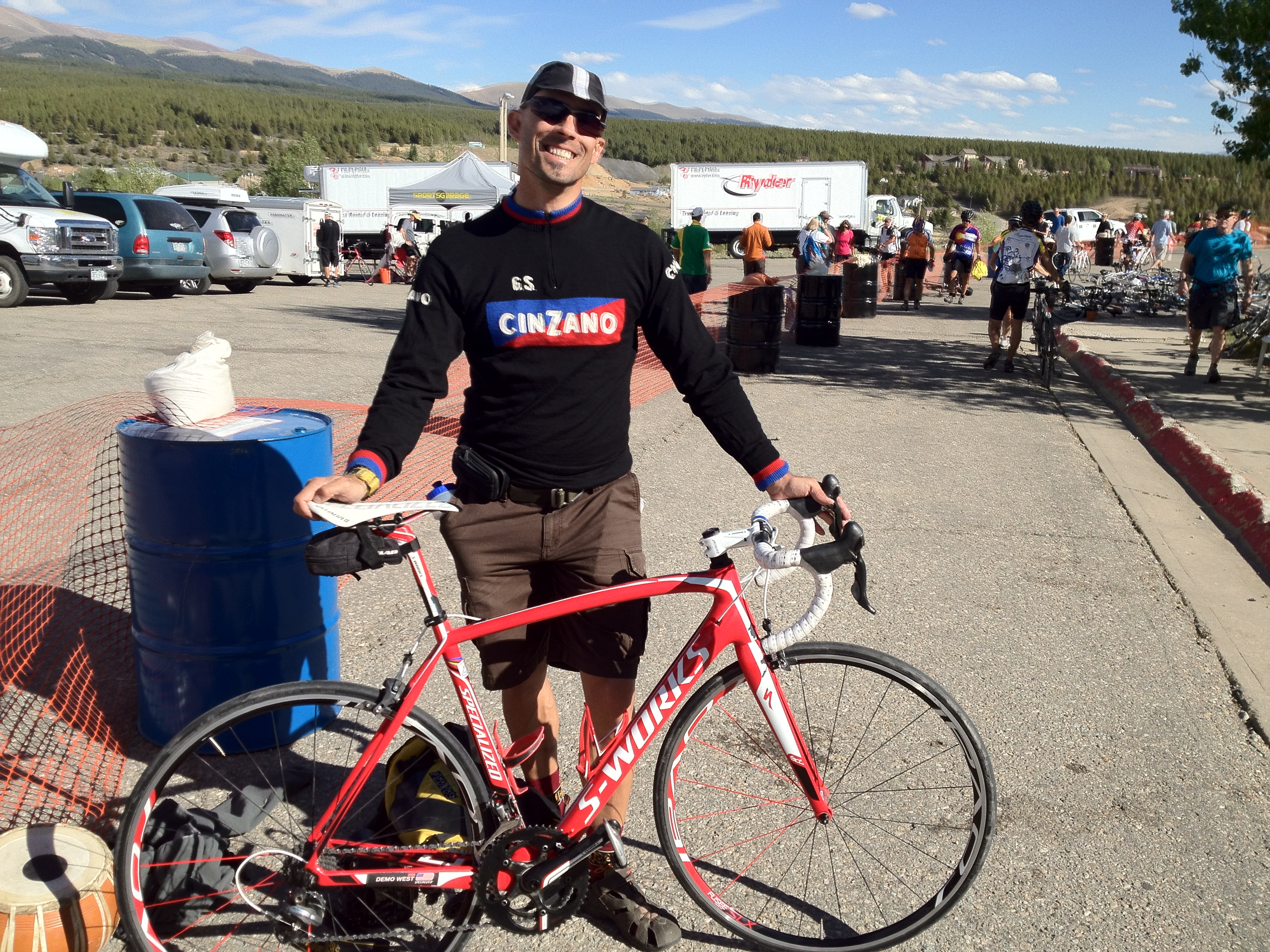
Andy Schleck

Andy Schleck wheels past awe-struck fans at the 2011 USA Cycling Challenge prologue in Colorado Springs in August. Schleck fell and fractured his pelvis during a June tune-up race and will miss the Tour de France this year.
Ride the Rockies Independence Pass – 12,038 feet, Cat. 1 climb
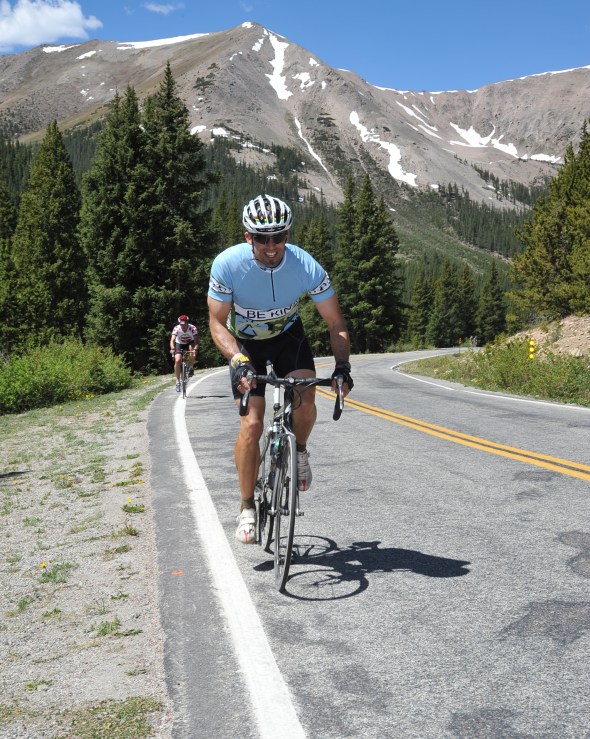
Me suffering on the Category 1 climb of independence Pass on the “Queen Stage” of Ride the Rockies. Sixteen miles, 4,000 foot elevation gain. Then a slow gradual climbing slog into Leadville over dirt and crappy roads. What a great day!
Thanks to Sundance Images for this shot of me suffering up Independence Pass. All of the great images of me suffering have been taken by the fine folks of Sundance Images! They are great.
The Unexpected
The best known advice for new adventures is “Expect the unexpected.” I’ve known it and have seen it play out on many occasions. I once blew the engine of a Dodge Colt at the Ohio – Michigan border. Then, on a different trip to see my mother and little sister, I, again, killed a car, then walked around a well-to-do Ann Arbor neighborhood trying to find a phone. It’s been a while ago. Wednesday morning, in Leadville, a fellow rider with the worst sleep apnea you can think of past on. The man, in his early 50s, died in his sleep when he couldn’t get enough oxygen at 10,200 feet.
Those were more negative examples. I have some great examples of much more positive sort. I have met long-time friends who do Ride the Rockies every year. I’ve met people who have come from islands, from the east coast, the west coast, from Wisconsin and many points in between. I’ve met a pair of of sisters who live in different parts of Colorado and come together for this event. They sing, they dance, they grill.
I’ve discovered that if I’m tired enough, I will sleep on a gym floor with hundreds of other worn-out cyclists. I will eat Powerbars as a meal when I run out of cash. I found that one can not thrive on Powerbars and dried fruit exclusively. At least I can’t. I can climb a category two climb in “Pro” gearing. It hurts, and it’s not fast, but I can do it.
I know how a saddle sore feels.
I know that if I go long enough without sleep, I can drift off and into a dream while typing.
Massage therapists deserve every cent they make, as do most bike mechanics.
No mater how advanced modern technology gets, it will still fail, and another bike ride, even after 250 miles of riding in three days, will make everything better, again.
I realized that there are plenty of other parts of our state of Colorado that I want to explore. There is much of this state I have yet to see. Further, while I’m a bit beat up and tired right now, I wouldn’t mind exploring by bike.
There are plenty of cyclist as well as drivers who don’t understand the concept of sharing the road. I have discovered that angry old guys in Leadville don’t know that 98 percent of cyclists, in America, own cars as well, and therefore do pay their fair share to use the road. I also heard a great argument stating we could tax cyclists more, but then you must let them use the entire lane.
Road bike tires do not like milled road surfaces.
Most bike mechanics are about the nicest people you want to meet.
Total strangers will share grilled veggies if you ask nicely. They will also open up, sing and dance. Really.
Managing a rolling town of 2,000-plus people is not always easy or smooth, but if done enough, no one will notice when things get crazy.
Everyone has a favorite and least-favorite variety of riding. Not everyone likes rough roads or headwinds. I don’t enjoy long climbs.
Almost anything tastes gourmet if it’s served after spending seven hours riding a bike.
Tiny towns will go out of their way to make you feel welcome in hopes that you might come back.
It only takes about three days before 2,000 strangers start to feel like a community.
And finally, as much as I’m enjoying all of this, like Dorothy in the Wizard of Oz, There is truly no place like home.
Have fun, be safe. I’m going riding.
One down . . .
So the first day of the 2012 Ride the Rockies is in the books. It was a fun and beautiful ride, cruising the north rim of the Black Canyon of the Gunnison. I had to admit, I liked knowing that the climbing was done at 48 miles in. I’m so tired and achy.
It was climbing for better than 45 straight miles, almost from the moment we got out of Gunnison. We had a few flat spots, like the bridge across a narrow part of he Blue Mesa Reservoir, to the big point along the way.There were plenty of picture opportunities as the striped rock of the Painted Wall beckoned. It seemed wasteful not to stop, with such great vistas spread out before us. The views of the San Juans far south of the canyon also helped to take our minds off of the heat and stinging pain in our legs.
After the climbing, there was a steep, bombing descent, followed by a long run into Hotchkiss. I didn’t have the sense to take it easy over the last10 miles, and hammered like a crazy person all the way in.
The ride organizers, who have done this for more than two and a half decades, know exactly what a tired rider need. At the finishing town, a small, mostly agricultural West Slope community of Hotchkiss, massage therapists worked out knots, the smoothy booth provided replacement calories and the local school parents and kids made dinner and lunch.
And so, now I am off to bed. Visions of a bored $8,000 race bike dancing in my head. Tommorow, an Aid Station rundown, as well as a look at the Specialized Venge Pro DA.
Six hours out, six days back
Drove from my home in Estes Park out to Gunnison, Colorado today. Through the Denver metro area, through South Park, through Buena Vista and Salida and finally ending up here.
I’m with several Ride the Rockies veterans, so I’m confident it will be great. My only concern is my lack of long miles before this ride. Due to the crash nine weeks ago, I’ve managed one long ride, and that one only 35 miles. This might hurt for the first couple days, but by the time we reach Independence Pass on Tuesday, I should be in good shape. We’ll see.
The Other Half
I was reminded this week, ever so gently, that I don’t often write about the women’s side of bike racing. This is an oversight on my part. There is plenty to report and enjoy from the women’s side.
Now that the men have finished up their tour of Italy, we are about four weeks away from the Giro Donne, or more formally, Giro d’Italia Femminile. They begin in Napoli with an 86-mile ride to Terracina. The race is nine stages through a smaller swath of Italy, and ending in a sprint into Bergamo, smack in the middle of Northern, Italy, after about 1,000 km.
One of the teams bound to make an appearance is the Specialized-Lululemon super team. The team dominated the General Classification of last week’s inaugural Exergy Tour in Idaho. American Evie Stevens took the overall in the new race, but her team dominated throughout.
The team took all of the podium spots of the stage-two time trial in Kuna, Idaho. American Amber Neben took the top step, covering the 10.4-mile course in 21:37. Teammate Evie Stevens was second, 15 seconds back, and Canadian teammate Clara Hughes slotted in third at 20 seconds back.
As a result, and continued hard driving, Specialized-Lululemon took all three podium spots on the GC. With Stevens on top, Neben was on the second step and Hughes ended up third.
Colorado has a tie to the history of the Giro Donne. The only American to win that race is Boulder’s Mara Abbott. This is not some fluke performance for Abbott, who won the Giro in 2010. She has won the Iron Horse Classic from Durango to Silverton on five consecutive occasions, a record for the race. This year, she covered the 47 miles over Coal Bank pass and Molas Pass in 2:44:35. That’s fast for anyone, and certainly faster than I could cover that terrane.
Unfortunately, I do not speak Italian, so I can’t really tell who will ride this year. The Specialized-Lululemon team has the Giro Donne scheduled, however. It should be a great test for the squad as they match up against the best European teams at the most important date on the women’s racing calendar.
I think I’m healed up, but I’m still trying to control myself. Returning to training after an injury is not quite as bad as sickness or starting anew. I still have to ease back in, however, or risk further pain and delays.
I have taken three short rides, one with a small group, none longer than 10 miles. Everything feels good, so far. I am monitoring my clavicle and not really lifting, so far. I’m only doing 10 pushups at a time, but it’s better than missing my biggest ride.
It’s tricky, returning. My gut instinct is to go crazy. Of course, that’s always the case for me, but now that I’ve been out so long and only have a week until Ride the Rockies, the urge is even stronger. I know, however, that a misstep now will ruin the summer. So now it’s slow and steady. If I’m good, I will get two long rides in. One to Rock Cut, and one to Ward, both slowly. It’s the only way I will get to do this ride, and document it for you, the readers.
By the way, I plan to have two new videos up on the Trail-Gazette Facebook page by the time this paper hits newsstands. This is my warm up. I will blog, photograph and post video on my experience on Ride the Rockies, as well as interviews with other Estes Park riders, interviews with interesting random people, demos and information on the towns along the way. Look for these updates on our website and Facebook beginning on June 9.
As always, have fun, be safe. I’m going riding.
Restart
One grand tour and one smaller tour are underway. It’s nearly crunch time for training, and for fund raising. By the time most folks read this, I’ll be out on my bike.
The weather has been nice, and while I’ve talked about it plenty, I try not to complain too much about my collar bone. I was surprised to discover just how far this column goes and how many people have heard about my injury.
I was hiking up to Gem Lake about 10 days ago and met a gentleman from Denver. He noticed my camera gear and sling and correctly guessed who I am. On Tuesday night, I was doing a shoot for Children’s Hospital, all the way down on their new Fitzsimmons campus. It was an event with big donors, department chairs and hospital and foundation executives. A donor, again after spotting the cameras and sling, asked if this was my column. It’s nice to know this is read all over.
So, I mentioned Children’s Hospital and donors. I got to see the new hospital up close. I got to see a few of the many children this facility helps every day. I’ve also managed to meet some of our locals over the last few years, who have benefited from this great hospital. It’s nice to be a part, even a small one, of helping this hospital. You can be a part, as well.
I am still trying to put together my team for the annual Courage Classic bike tour. The important part is the fund raising. Riders raise money for the hospital, providing funds for them to purchase equipment, recruit top-notch talent and finish this state-of-the-art facility down in Aurora. All of this for the benefit of Colorado’s children.
There are two ways to help out. You can join me. Go to couragetours.com/2012/team/estes and sign up. Do to schedules, we are low on riders. We would welcome new team members. If you can’t or don’t wish to ride, you can always donate. Go to the same web address, pick a rider, and donate. It’s actually pretty easy.
If you don’t already know, the ride, itself, is three days around Leadville, Vail and Summit County. The riders are friendly and pleasant. The scenery is breathtaking and the support is the best of any ride I have ever done. The support consists of volunteers mostly from Children’s Hospital, so they’re cheerful people, anyway. The organizers also promote a contest among the aid stations, so they are competitively happy and enthusiastic. The real heart-warming icing on the cake is Team Courage. This is a team of kids and their parents who have been treated at Children’s Hospital. The festivities on Saturday night include introduction of the team, to cheers and hugs. On Monday, the last day of the event, the whole team masses and then crosses the finish line together.
Riders of the event get medals at the end, but the real reward is knowing you’ve helped this wonderful hospital. This will be my fifth year, and I hope to do it for many years to come. I would love to have some new friends to join me.
In the professional world, 22-year-old Slovac Peter Sagan of the Liquigas-Cannondale squad has absolutely dominated this year’s Amgen Tour of California. The young sprinter has won the first four stages, and has worn three of the for competition jerseys; best young rider, sprinters points and the yellow jersey of the overall leader. He may have trouble on Thursday with the Bakersfield time trial, however. All of the top GC contenders, including defending champ Chris Horner, are withing 30 seconds of the lead.
Friday will also be a challenge for most sprinters as the stage starts in Palmdale, north of Los Angeles, and heads west for a big climb and a finish at Big Bear Lake. The problem, for the rest of the field, is that Sagan won the climb to Big Bear last year. If Sagan can hang tough in the time trial, look for him to win the race and take home his first tour overall win.
Over in Italy, irony took headlines at the Giro d’Italia on Wednesday. Roberto Ferrari won the bunch sprint after yet another crash in the final kilometer of the stage. Before Wednesday, Ferrari was best known as the erratic sprinter who crashed world champ Mark Cavendish and GC leader Taylor Phinney in the last 100 meters of the first road stage of the race, a week ago Sunday. Phinney has not ridden very well since and Cavendish has looked tired, though he did pick up a sprint victory last week.
Joaquin Rodriguez of the Katusha team leads the overall. Canadian Ryder Hesjedal of the Garmin-Barracuda squad is 17 seconds back. Several overall contenders are within one minute of the lead and the race has not yet hit the high mountains. The year’s Giro is completely up for grabs with eight stages left. This should be fun.
Have fun, be safe. I’m going riding. Really.
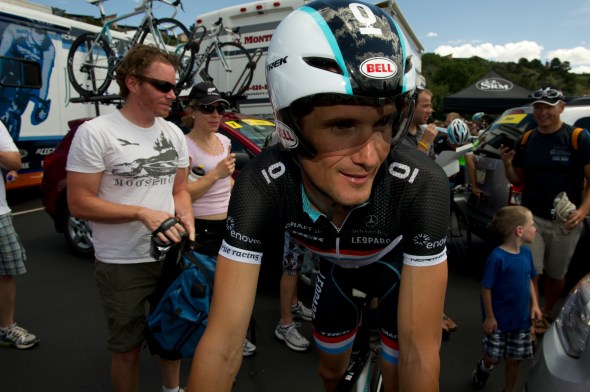
Frank, up close
Saturday marks the start of the 2012 Giro d’Italia, the tour of Italy, and it should certainly be a good one. The flash and style, the torturous climbs, the lightning-fast sprints and the tiffosi, the crazed Italian fans, the Giro is an amazing event.
While the Tour de France has its traditional feel, awarding what looks like a Greek bowl as its award to the winner, Italian style abounds and is reflected in the Giro’s trophy, a two-foot tall spiraling gild ribbon with the names of past winner etched in it. It is Italian art all by itself.
As you might imagine, for most Italian riders and teams, the Giro is the most important of the three grand tours. To race in front of the home fans on the roads on which many of them train is a rare treat. In every one of them is the fantasizing boy, chasing Fausto Coppi or Marco Pentani up the near-vertical climbs. Each sprinter, though now a pro, imagines himself sprinting against the Lion King, the legendary and flamboyant Tuscan, Mario Cippolini, record holder for most Giro stage wins. It’s the brutal beauty of the epic stories, like Andy Hampsen’s heroic conquest of the snow-covered Gavia Pass. But cycling is so much a part of Italy, and Italy so much a part of cycling that there is much more than even the Giro to celebrate.
Cycling is such a part of Italy that the fans have their own special name; the Tiffosi. They will push riders. They have been known to assault others. They will ride the same roads and wait for a week to catch a colorful flash of their favorite riders as the fly past.
Take a ride to a coffee shop. Sip espresso with your shaved legs up on a chair. Sport that retro cycling cap. My wife hates that cap, by the way. I own five of them.
I own a replica of the 2007 sprinters’ kit awarded to Italian Alessandro Petacchi. It is an outrageous magenta. Imagine a giant-thighed sprinter in hot pink coming at you like a missile. That is Italian style. In this edition, the sprinters will fight for a bright red jersey, the shade of the stripe on the Italian tri-color flag.
Waif-like climbers have worn the other prominent color of the flag, green, until this season. This year, with a change in sponsorship of the best-climber category, blue will be the color of the Re delle Montagne. Blue, of course, is steeped in Italian sports tradition, itself. The Italian national teams, whether soccer, rugby or cycling all ware the fabled azzuro.
Like the other grand tours, white is the color for the best young rider of the Giro. Maglia Blanca was won in 2007 by Andy Schleck. At the time, fans knew he was the younger brother of Frank Schleck, but until he nearly stole the GC from The Killer, Danilo Di Luca, no one knew how good this kid was. A rider must be 25 years of age or younger. The idea being that a rider really needs to be a certain age before a body can handle the demands of three weeks of racing.
The one jersey every Italian cyclist dreams of, however, is the color of a baby girl’s blanket; pale pink. The Maglia Rosa is the shade of pink once sported by the Gazzetta dello Sport, the Italian national sports journal. The paper was the driving force behind the race in its infancy. It is still a major force behind the organization, though it is a more traditional newsprint color today.
The pink jersey has been worn by the superheroes of cycling. It was won by Eddie Merckx on five different occasions. Italian legends Learco Guerra and Alfredo Binda each took five pink jerseys home, as has Costante Girardengo and Roberto Visentini. Fausto Coppi accounted for six pink jerseys, though even he was not the best of the best for the jersey. The great Francesco Moser holds the record. Moser won eight Maglia Rosas between 1976 and 1985.
So grab some espresso and a plate of brioche with some marmellata on top and get ready for three weeks in Italy. The Giro is about to begin, and it will be a good one. Ciao!
Have fun, be safe. I’m going riding, if only in my imagination.
Things could be worse as the summer season nears
I’ m busy this week doing one of those things I can do when I can’t get outside to ride. I’m watching old race recordings. The Spring Classics season is coming to a head, but I won’t get to see those races until at least Sunday. Meanwhile, I have the 2003 Tour de France to keep me entertained.
If you don’t remember, the 2003 Tour was the closest of Lance’s seven Tour victories. He came into the race after fighting a nasty bug and while his marriage to Kristin was falling apart. Armstrong did not have the focus or the fitness everyone was used to up to that point. The race itself, from the rider’s standpoint, was a mess.
The first week of a grand tour tends to be a crash-fest, anyway. But the crashes that started this tour were exceptional. On the first road stage, Tyler Hamilton would be involved in a pile-up that nearly ended his race before it started.
Inside, the final kilometer, just one bend from the finish line, and with all of the sprinters charging, Kelme rider Jose Enrique Gutierrez over-cooked the sharp turn and put a foot down, causing a chain reaction. The crash stopped all but the front 25 riders, and sent Hamilton to the pavement. The crash broke his collarbone. As luck would have it, the bone was broken in a spot close to where the same bone was broken in the Giro d’Italia about 14 months earlier.
In the 2002 Giro, Hamilton would ride the whole race with the brake, and grind down several of his teeth, jaw clenched against the pain. Hamilton would do it again in the 2003 Tour, resulting not only in a fourth-place finish, but also in bolstering the quiet, slight, former Colorado resident’s legend. The worst, however, would happen a bit over a week later in the Alps.
During stage nine, T-Mobile rider Alexander Vinokourov put 30 seconds between himself and the group containing the top contenders. The group was screaming down the mountainside toward the town of Gap, trying to catch the Kazakh rider, and was making up time when, on the gooey melted tar, Spaniard Joseba Beloki, sitting 40 seconds behind Lance in the GC, lost control of his bike and he hit the tarmac at about 40 mph. The crash resulted in a broken leg, elbow and wrist. Beloki never regained the form he had before the crash. Most Americans remember the incident for Armstrong’s quick reactions. He cut the switchback, riding his bike through a farmer’s field and regaining the pack as they came out of the next bend.
One could argue that this whole Tour hinged on the crashes, and on Armstrong’s luck. Beloki was well within striking distance when he crashed. Hamilton went on to score a stage win on a long breakaway, collarbone in bandages. Don’t forget the stage 15 climb of Luz Ardiden in which a spectator’s bag handle hooked Lance’s handlebars, throwing him to the pavement and Iban Mayo on top of him. Hamilton went to the head of the race to slow Ulrich and company down to allow Lance to get back on. Lance would win that stage. And then there was the big one.
On the race’s final time trial, a 30-mile race against the clock from Pornic to Nantes, Jan Ulrich crashed around a bend on the rain-soaked street. Ulrich had beaten Armstrong by more than 90 seconds in the race’s earlier TT, stage 12 from Gaillac to Cap Decouverte. Ulrich was less than a minute down, but the crash would end the enigmatic German’s bid, and all of the crashes would define those involved.
Ulrich will forever be known as a bridesmaid to Armstrong. Hamilton’s actual racing will be remembered as tough as nails. Beloki will be the rider who could have been. Vinokourov, the only rider not involved in the crashes directly, will be the rider who threw caution to the wind and took ridiculous chances on seemingly pointless solo attacks. Vinokourov’s career seemed to end in a crash, as well.
On stage nine of the 2011 TDF, on another snaking descent, Vino would carry too much speed into a corner, fly off the road and break his leg. Vino claims he won’t retire, just yet. He plans to ride in the London Olympics, less than 100 days away, now.
Yah, okay, I’ve crashed, again. I’ve even broken something. This is my third major crash requiring medical attention in the last 17 years. It won’t stop me. I suppose that’s the beauty of not being a professional. A few more weeks and, like a dog off his leash, I’m off again.
Have fun, be careful. I’m going riding . . . eventually.
A speed bump!

I hit the dirt between Exposition and Cherry Creek Drive a couple weeks back. I have four weeks 'til I can ride outside. Grrrr.
Don’t do this at home!
So, I’m screaming along University Blvd. in Denver, thinking, “my wife will kill me if I’m late for Passover dinner,” when I spot what I initially think is a very narrow driveway. By the time I realize that it is a rain culvert, I’m already down to one option. “MUSTBUNNYHOP!!” I didn’t make it.
There was a split second when I thought “hey, I just might make it,” then the sharp, sickening pain in which everything I see is white, and everything I say if profane.
While clutching my shoulder and swearing, I check my bike. Have to retrue the front wheel. Crap, I think, I’m gonna be late, now. Nothing bleeding, better get going.
By the time my wife sees the shoulder, it’s beginning to turn a faint yellow-green. A bruise. That is to be expected, I think. Meanwhile, my wife’s family points out that this night would not be the first time someone had to be taken to the ER for Passover Seder. I’m thinking, “okay, it hurts, but I can move it around. It might be jammed, but in a few days, it will be fine.”
The next day, purpleness begins to come through in the space between my collar bone and my trap muscle. Still, I think nothing of it.My wife, always the careful, practical and medically educated one extracts from me a promise to see our sports doctor back home. Better to be safe rather than risk losing the whole summer riding season.
I was still surprised and disappointed when the doctor and his assistant walked in after looking at my x-rays, sling in hand.
“You broke it.”
“NO!”
“Oh yeah. In two places”
The doc shows me the unmistakable spikes and shadows on the image showing just what kind of damage I had done. One looked like it had been peeled up off of the bone. The other was a faint, gentle wave.
The swelling and that I still have a little of the mass from my former life as a bodybuilder saved me from much more pain. Still, I would not suggest this as a way to pass time. I now have a nice black sling.As you already know, black goes with everything.
I find I can still ride the stationary trainer, but I won’t get to do much upper body work. I won’t get to do the CrossFit classes that helped maintain the muscle that saved me from more server damage. I’ll just have to focus on my legs. I’ll still be able to Ride the Rockies, as well as riding the Courage Classic. Those are both in summer. I’ll just do it with a different mind set.
I wrote about pulling out of the Boulder-Roubaix to avoid this exact injury. I crashed inspire of the decision. I was focused on the broken collar bone, and that’s what I got. I spent money last September on a positive self-talk seminar, then forgot everything CrossFit hero Greg Amundson tried to teach. He even sited a story very close to my own. An Army Ranger he trained with said to himself, “Watch, I’ll be the guy who breaks his ankle on this course.” Sure ‘nough.
I know better. I have to watch what I think and how I think. Positive thoughts tend to bring positive results. With that in mind, I’m going to do everything my doctor tells me, exactly the way he describes it. I will be ready to rock by the Duck Race. That will give me five, happy, warm weeks to train long riding before the Ride the Rockies. Watch. It’ll happen.
Meanwhile, have fun, be safe. I’m going healing, and riding my trainer.
Summer opportunities just keep coming!
It’s still chilly as I write this week, but the promise of spring is in the air, and my riding calendar is filling, and thrilling. Just as thrilling are the opportunities that modern technology are opening up for me.
I hinted last week at what lies ahead of me this summer. Our new publisher is almost as enthused about this June’s Ride the Rockies as I am. Armed with a new iPhone, look for a video piece, as well as regular entries to both the www.eptrail.com website and Facebook page that will compliment this column. In the run-up to the big annual tour, I will hunt down helpful hints and experts with help for those planning similar rides this summer.
If you are a fellow cyclist with questions or suggestions for the video, contact me at walt@walthester.com with what’s on your mind. If you don’t ride, but want to get involved, as the Ride the Rockies will be spending the night here, contact us to put your logo on my back as I lead the sweaty and doubtless hungry, thirsty, and sore peloton into our beautiful town. I don’t mind wearing logos. It helps fulfill my fantasies of being a sponsored athlete.
Significantly further up the cycling food chain, the first European stage races began this week. The “Race to the Sun”, Paris-Nice, started on Sunday with a short time trial that, surprisingly, did not see world champion Tony Martin of Omega Pharma-Quickstep crush all comers. The young German finished 25 seconds and 27 places behind Swedish National Time Trial Champion Gustav Larrson of Vacansoleil-DCM. After five of eight stages, several leaders have emerged to challenge for this race’s yellow jersey. American Levi Leipheimer, now riding for Omega Pharma-Quickstep, fellow American and part-time Colorado resident Tejay Van Garderen of BMC Racing, Brit Bradley “Wiggo” Wiggins of Team Sky and Movistar’s Alejandro Valerde are jammed in within 39 seconds of each other. Of those, Van Garderen is the least likely to emerge on top once they get down to the Mediterranean coast.
Unfortunately for many riders, illness is as big a factor as any this year. Both Andy Schleck and Andreas Kloden of the RadioShack-Nissan-Trek, as well as Taylor Phinney of BMC, have pulled out of the race siting gastroenteritis.
Meanwhile, in Italy, the Tirreno-Adriatico has begun. Australia’s new super team, Green Edge, won the opening team time trial on Wednesday, giving the first leaders jersey to Matt Goss. On stage two, the Manx Missile, Mark Cavendish, took the bunch sprint.
While Paris-Nice is considered the test for climbers, the “Race of the Two Seas” is very much a sprinter’s race. Along with the large lovers of flat terrain, possible contenders include last season’s Tour de France champ Cadel Evens, riding for BMC, and American Chris Horner, riding for RadioShack-Nissan-Trek.
You may already know that the Ride the Rockies’ biggest sponsor is the Denver Post. Did you know that most of the big races, and even rides, that you have heard of were originally promotional events for newspapers?
In fact, the two most celebrated jerseys in pro cycling, the Tour’s Maillot Jaune and the Giro’s Maglia Rosa, get their colors from the pages of the newspapers that started the races. The French newspaper L’Auto’s pages were yellow at the time of the first leaders jersey, rumored to be in about 1903. The pink pages of the La Gazzetta dello Sport was the inspiration for the jersey for the annual tour of Italy. Iowa’s Register’s Annual Great Bike Ride Across Iowa, aka RAGRAI, is sponsored by the Des Moines Register, following this distinguished tradition. Without newspapers, the races and rides we know and love would look completely different. Just something to think about.
The weather is warming, so have fun, be safe. I’m going riding.
Where’s Walt
Interview with Ron Keifel and organizers of the Children’s Hospital Colorado’s Courage Classic.
 Walt Out West